


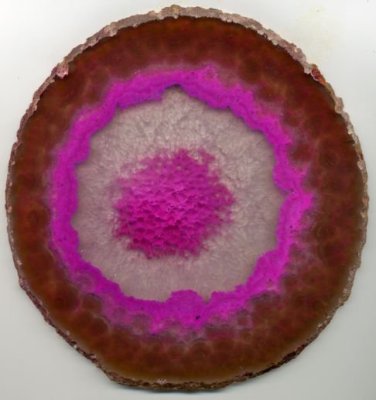
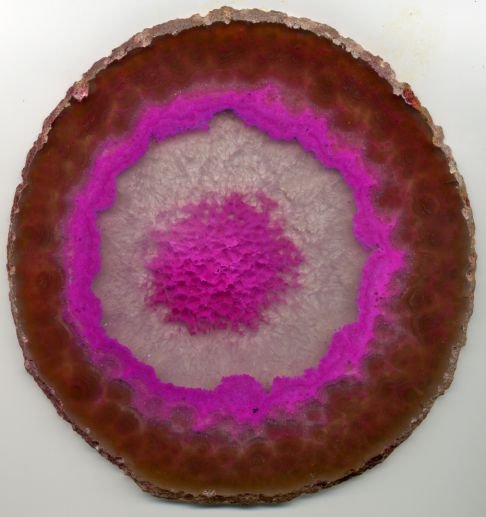
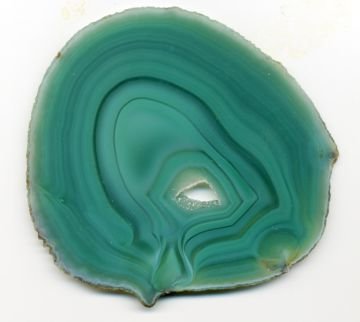
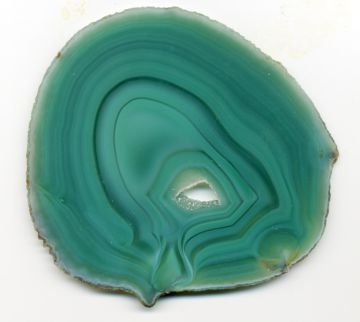
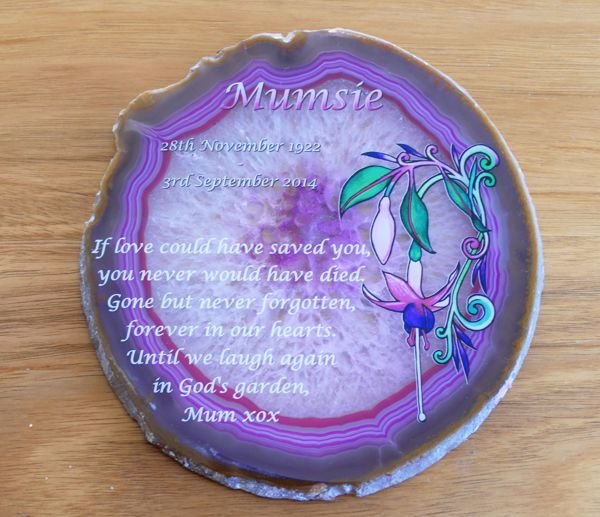

Polished Agate Large
Large Polished Agate slice
Engraved cut and polished agate
Engraves with crisp image including your photo if you wish.
ideal home display.
indoor or outdoor. A memory for your loved ones

- Shipping info
We deliver worldwide By Australia Post
- Payment methods
X-Payments ( Credit Card ) PayPal ( accepts credit card ) Square ( Credit card ) Bank Transfer
- Return Policy
Custom engraved products are made on your approval of proof emailed to you. at receipt of order
These cannot be returned
Agate section is polished front and back.
During agate growth, the first deposit on the wall of a cavity, forming the "skin" of the agate, is generally a dark greenish mineral substance, like celadonite, delessite or "green earth", which are rich in iron probably derived from the decomposition of the augite in the enclosing volcanic rock. This green silicate may give rise by alteration to a brown iron oxide (limonite), producing a rusty appearance on the outside of the agate-nodule. The outer surface of an agate, freed from its matrix, is often pitted and rough, apparently in consequence of the removal of the original coating. The first layer spread over the wall of the cavity has been called the "priming", and upon this base zeolitic minerals may be deposited.
Many agates are hollow, since deposition has not proceeded far enough to fill the cavity, and in such cases the last deposit commonly consists of quartz, often amethyst, having the apices of the crystals directed towards the free space so as to form a crystal-lined cavity, or geode.
On the disintegration of the matrix in which the agates are embedded, they are set free. The agates are extremely resistant to weathering and remain as nodules in the soil or are deposited as gravel in streams and shorelines.
Select unique stone, and add your Text, choose Font.
Polished agate engraves with crisp clear image showing fine detail
Photo can be engraved as you require
You supply photo by email after confirmation. use Order Number as ref in email.
Submit clear photo for best results.
Proof supplied
Every piece is different in size and shape only availiable until sold.
Select your unique stone from Drop down list to see image of ACTUAL PIECE
Image and Price is shown for piece you have chosen
- ManufacturerMyChoice@Firebridge
- Size and Colour175 x 165 mm x 6 mm Pink, 170 x 160 mm x 6 mm Green, 120 x 100 mm x 6 mm Green
- Photo SuppliedNo, Upload my photo
- MotifNone, Order motif as separate item, Describe in Instructions, upload my own motif
- Line1 FontArial, Arial Bold, Arial Itallic, Bauhaus, Bodoni MT, Bradley Hand, Broadway, Brush Script, Curlz, Forte, Freestyle Script, Garamond, Gigi, Harlow, Jokerman, Kristen IT, Lucuda Calligraphy, Lucida Handwriting, Magneto, Mistral, Old English, Papyrus, Parchment, Pristina, Rage Italic, Ravie, Times New Roman, Time New Roman Bold, Time New Roman Italic
- Additional FontArial, Arial Bold, Times New Roman, Times New Roman Bold, Times New Roman Itallic
- VallyJan 20, 2017, 12:00Thank you for the beautiful memorial. The agate looks really beautiful and the picture and writing are perfect.
We ship using Australia Post parcels
Regular and Express options are available for National delivery
and to your own Country
We accept the following payment methods:
PayPal ( accepts credit card ) Square ( Credit card ) Bank Transfer
Products are made to order
On placement of order confirmation is emailed to you
If you have any image to be used on product
Return email with image/s attached.
A layout proof is prepared and emailed to you as pdf file.
Once final layout is approved, then this is what is made.
Product received in good condition as per proof is NOT returnable
If you do have issue with quality of your receipt, then send photo and reasons
In approved cases a replacement product will be made